
Road transport products
working since 1978
Updated to:
Order your placarding requirements ONLINE NOW. It's as simple and quick as 123.
|


Dangerous Goods Placarding for Road Transport
The purpose of hazard warning placards is to identify the dangers associated with a particular cargo so that appropriate information can be sourced to deal with an incident involving spillage or fire. The South African placarding system for road transport is set out in SANS 10232-1 and outlined below.
Responsibilities
The consignor must supply the operator with either the placards or information to ensure that the vehicle is correctly placarded for his consignment, the driver must see that the placarding is in place and the dangerous goods loading supervisor (nominated by the consignor) must not allow a vehicle to move without the correct placarding.
Although the S A Standards governing the transport of dangerous goods by road omits to charge the carrier or operator with placarding responsibility, it stands to reason that he is also legally responsible, especially if he is carrying different classes of dangerous goods for more than one consignor, or if he is involved in picking up and dropping off goods while in transit.
Correct placarding
In order to properly placard a vehicle, you must:
- review the shipping documents
- observe the package labels
- refer to the Dangerous Goods List>.
The main placard
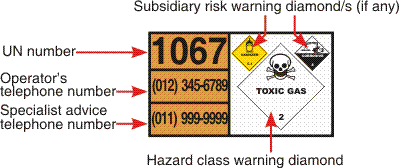
The 700 mm x 400 mm placards are divided into information zones which identify the goods, display emergency telephone numbers and the appropriate class primary hazard warning diamond along with smaller subsidiary risk diamonds where applicable. These must be displayed on both sides and at the rear.
Emergency telephone numbers
- The operator's number is where the vehicle operator/owner can be contacted
- The specialist advice number is the number of a party that can supply specialist advice on the hazards associated with the cargo. This may be the consignor/supplier/manufacturer or one of the spill response companies such as Spilltech.
- The specialist advice number and the operator number may be one and the same, providing the operator is able to give specialist advice. This is usually not the case but in the case where a company is transporting its own commodities, it sometimes is.
- There is space for up to two numbers each, one of which MUST be a landline.
- Both sets of numbers must provide a 24-hour contact facility
Warning diamonds
The appropriate warning diamond (250 mm x 250 mm sides) must be displayed for the hazard class being transported.
Subsidiary risk diamond
Where the Dangerous Goods List> indicates a subsidiary risk, the placard must also carry the approriate hazard class warning diamond/s (100 mm x 100 mm).
Mixed Load placarding
|
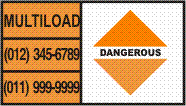
Where goods belong to more than one hazard class/division the phrase “MIXED LOAD” replaces the UN number and the “DANGEROUS” warning diamond is used. |
 |
Where goods belong to the same hazard class/division the phrase “MIXED LOAD” is used along with the appropriate warning diamond, instead of the “DANGEROUS” warning diamond. |
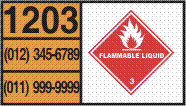 |
Where goods are of the same hazard class/division with the same emergency response guide the appropriate warning diamond is used along with the UN number of the most dangerous substance and its subsidiary diamond where applicable. For diesel (UN 1202), petrol (UN 1203), kerosene/paraffin (UN 1223) and aviation fuel (UN 1863), UN No 1203 is used. |

Reduced size placards for vehicles below 3 500 kg GVM
On light delivery vehicles such as panel vans and bakkies, the main placarding may be half size (ie 350 mm x 200 mm. The hazard class or multiload warning diamond is reduced to 100 mm x 100 mm sides and subsidiary risk diamonds are not required. The plain orange danger warning sign at the front is also reduced to 100 mm x 100 mm.
Prohibition signs
 |
SANS 1157, to be incorporated into the dangerous goods regulations under the Fire Brigade Services Act, provides a checklist for municipal fire departments when issuing permits for the transportation of dangerous goods. This standard requires that these three signs be displayed on both sides and at the rear on all vehicles used to carry dangerous goods. The prescribed size is 290 mm dia for heavy goods vehicles and 150 mm dia for vehicles less than 3 500 kg GVM. |