
FOR OPTIMAL CLARITY
Updated to:
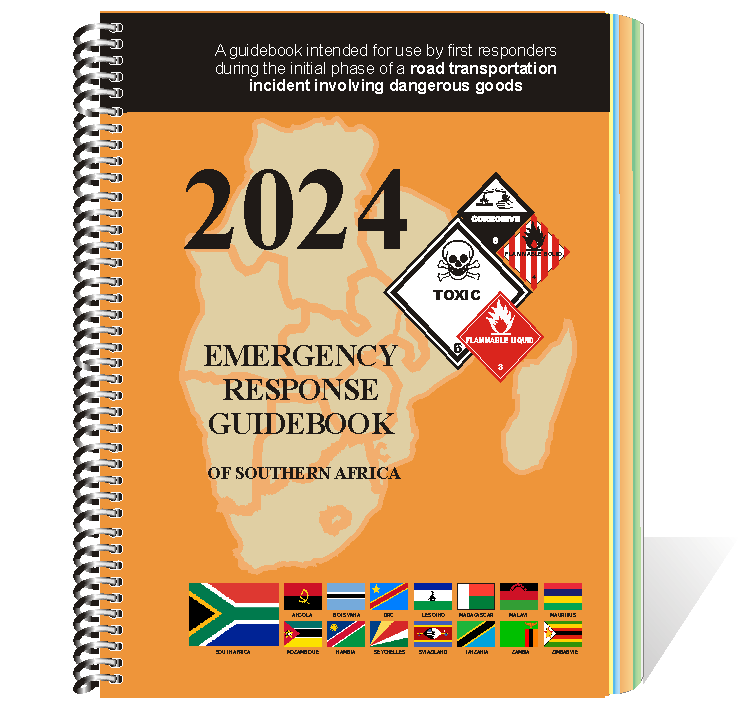 The EMERGENCY RESPONSE GUIDEBOOK of S Africa Developed from the acclaimed N American ERG (revised every four years) this publication has been meticulously compiled to dovetail with the emergency response system employed in Southern Africa. The law requires that the ERG book be strictly adhered to when dealing with a dangerous goods incident involving fire or spillage occurring on a public road More> |


Dangerous Goods Digest
Volume 1
Chapter 1: Legislation
Introduction, International regulation, What the law expects, Common law, Statutory law (includes an outline of the relevant parts of the Occupational Health and Safety Act> and the National Road Traffic Act>), SABS/SANS standards> (includes an outline of all the relevant codes and specifications).
Chapter 2: Classification
Identification (the UN number), System of classification>, Class 1: Explosives, Class 2: Gases, Class 3: Flammable liquids, Class 4: Other flammables, Class 5: Oxidizers and Organic peroxides, Class 6: Toxic and infectious substances, Class 7: Radioactives, Class 8: Corrosives, Class 9: Miscellaneous, Danger/packing groups, Subsidiary risk, Compatibility, Difficulties in classification (includes generic or not otherwise specified substances, aerosols, mixtures, waste, empty conainers and precedence of hazards).
Chapter 3: Operational Requirements
Consignor’s responsibilities, Operator’s responsibilities, Consignee’s responsibilities, Loading and offloading, Exempt quantity, Mixed load consideration, Load compatibility, Driver’s responsibilities, Routing of vehicles, The driver, Huguenot toll tunnel restrictions, Special provisions concerning the use of IBCs, Portable tanks and road tank vehicles, Cargo stowage and containment
Chapter 4: Documentation
The vehicle, Driver’s documents, Cargo documentation, Transport emergency cards>, Insurance, Incident reporting>.
Chapter 5: Packaging, Marking and Labelling
Chapter 6: Placarding
Information on the placards, Warning diamonds>, Placement, Other signage (includes elevated temperature and fumigation signage), Low hazard placards.
Chapter 7: Vehicle Design and Inspection Requirements
Requirements for all vehicles, vehicles transporting flammables and vehicles transporting hydrogen peroxide. Road tankers, Tank specifications. Vehicle inspection requirements, Issuing of transport permits for flammables..
Chapter 8: Explosives and Radioactive Materials
Chapter 9: Emergency Response
The driver, Communication of information, First responders, Fire and spill control, Decontamination, Recovery, Rehabilitation.
Chapter 10: Special Provisions
A complete set of the special provisions applying to certain commodities*
Chapter 11: IBC Instructions
Full set of instructions applicable to the use of intermediate bulk containers *
Chapter 12: ADR Portable Tank Instructions
Full set of requirements relating to the use of portable tanks*
Chapter 13: ADR Road Tank Special Provisions
Full set of special provisions when transporting by road tankers*
Chapter 14: Road Transport Special Provisions
Full set of special provisions for carriage of different commodities, concerning packaged goods, goods in bulk, loading and offloading as well as operational requirements*
Chapter 15: Additional Information
Glossary of terms, Abbreviations, Competent authorities, Approved dangerous goods training bodies, Index.
*As identified in the Dangerous Goods List in Volume 2.
Dangerous Goods Digest main page>
Vol 2>